Droso Kurs and more
on Friday, April 22nd, 2016 6:18 | by Christian Rohrsen
Here I attach the results in a pdf file from the students praktikum with an additional line I tested on my own meanwhile (Gr28bd and TrpA1 drivers together). They seem to work as a really good positive control btw, good for technique optimization.
For the students I tried out two different split drivers, the MB058B, which targets PPL1-a’2a2, and MB301B, which targets PAM-b2b’2. In addition the Gr5a driver, because it targets the “sugar” neurons. From the split drivers I wanted to see if I still get a validation from my initial model. MB301B seems to do quite what my model would predict but MB058B maybe not. Hopefully in a future screen I would be able to test many more and make a much more precise modelling.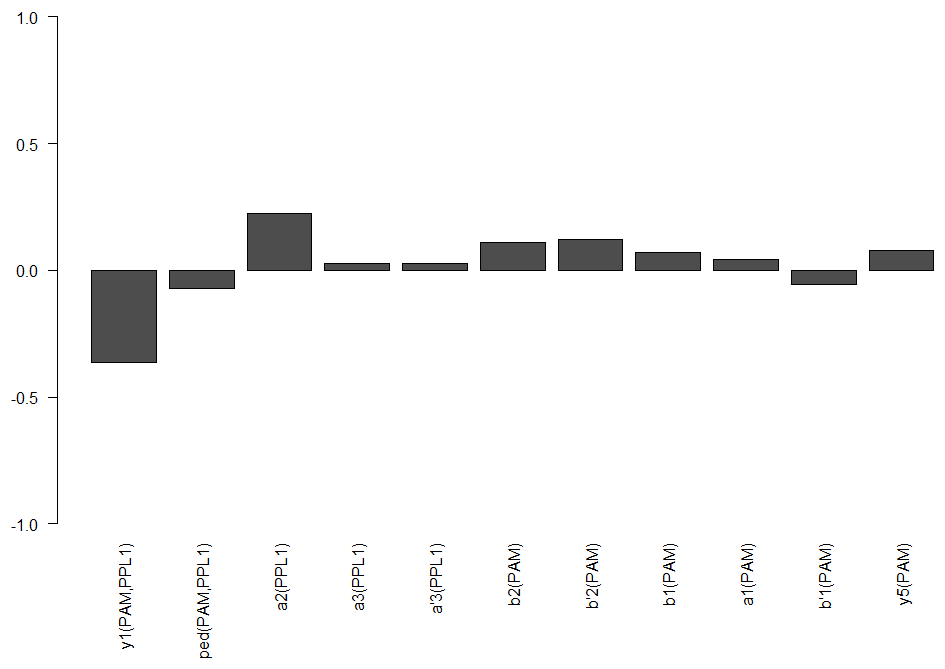

Category: neuronal activation, Optogenetics, R code | No Comments
Modelling the T-maze screen
on Monday, March 14th, 2016 1:35 | by Christian Rohrsen
This is the markdown showing the protocol and results of the modelling for the choice in the T-maze. This is for calculating valence. Nevertheless, this needs to be confirmed with the results of more lines, it could be that it is overfitted, I would like to do in addition cross-validation. I´m actually doing crosses and finding new lines to have more lines to test.
Category: neuronal activation, Operant learning, Optogenetics, R code | 1 Comment
Optogenetics – My results vs. Lena’s results
on Monday, November 23rd, 2015 2:42 | by Katrin Hofweber
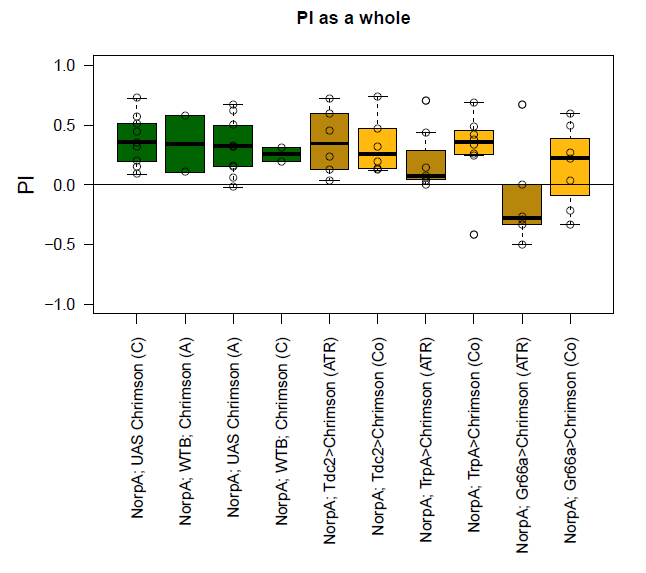
Last week I continued the experiments for the optogenetics. These are my results:
and these are Lena’s results:
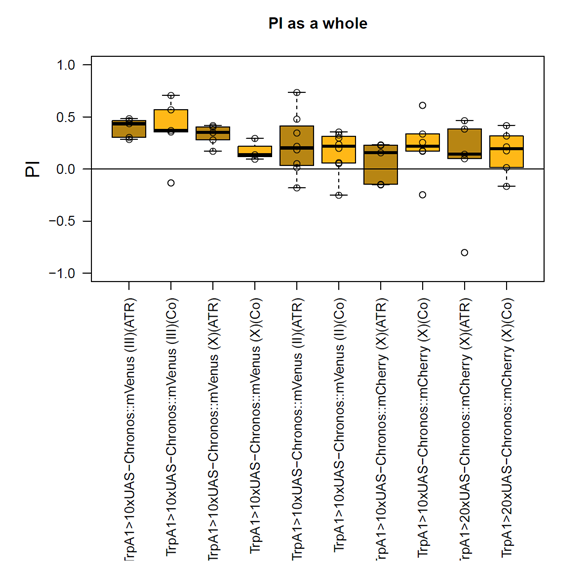
Compared to Lena’s results, my results are a bit too positive.
Usage of TrpA with infrared lamp
on Wednesday, February 13th, 2013 11:40 | by Christine Damrau
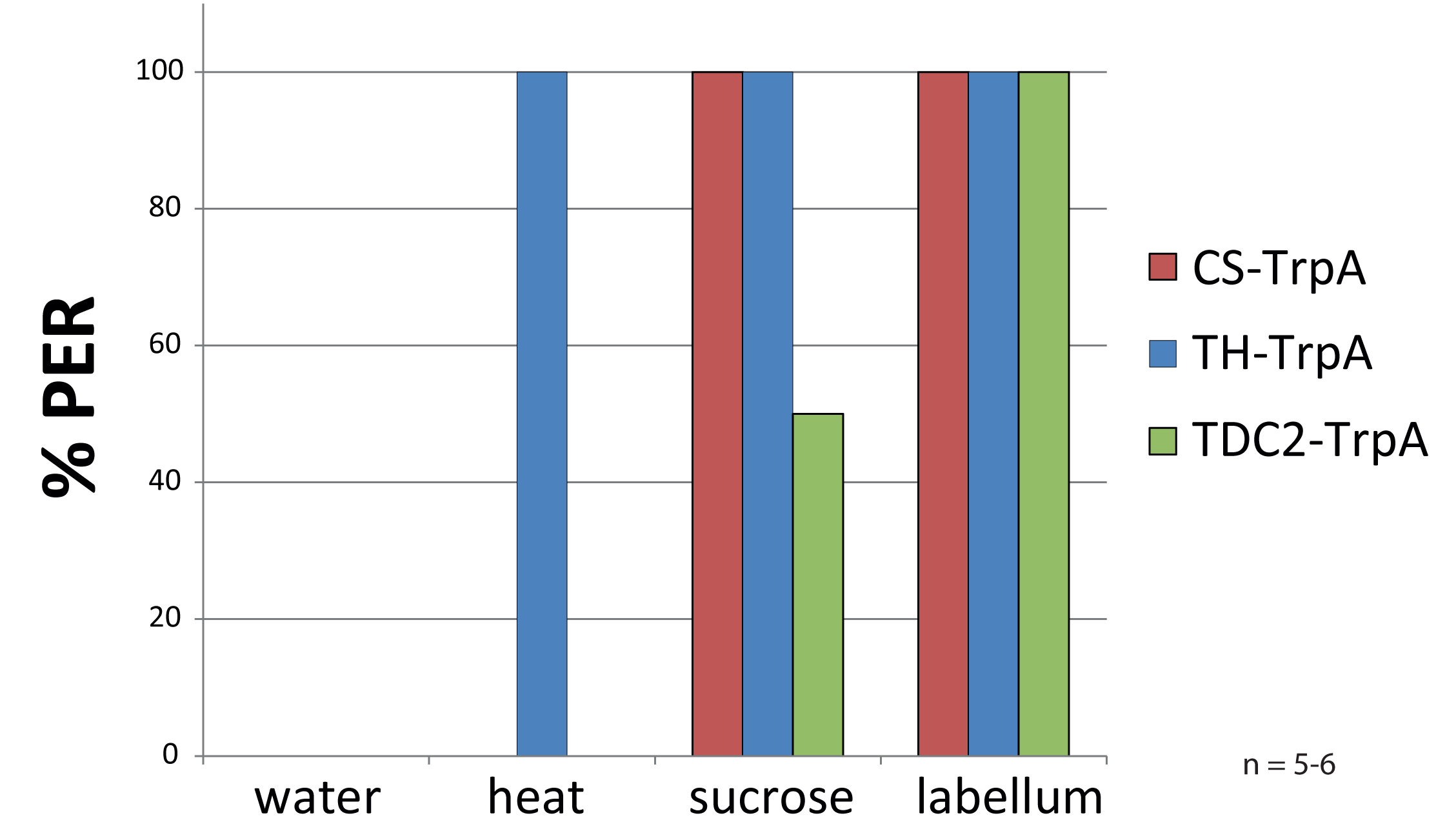
As a pilot for future experiments I tried to reproduce results from Keene et al., 2012. There, they substituted sugar by a laser to provoke PER after 24h of starvation (females, one week old). In TH-GAL4 they found 100% response when they pointed the laser to head or thorax. In tdc2-GAL4 indeed they found 50% of flies responding to heat but only when the laser was pointed to the thorax but not to the head.
Since we do not have this kind of laser, they used, I played around with an infrared light. Flies were fixed to hooks and a clamp as always. First, there was given a filter paper soaked with EVIAN-water (negative control), then there were 10s of heat (36-38°C), afterwards two positive controls: 30% sucrose on the legs and finally on the labellum.
In the figure, you can see that I am able to reproduce the methods with an infrared lamp instead of a laser. The TH-GAL4 flies crossed to TrpA respond much more to heat compared to the controls (see figure in blue and red). The proboscis extension appears already after a few seconds.
Unfortunately, I could not reproduce the results for tdc2-GAL4 (see figure in green). There was no response to heat found at all. (tdc2-GAL4 has to be ok, because I see fluorescence when crossed to GCaMP). Interestingly, the flies did not respond as strong to the 30% sucrose as expected. The starvation may have to be longer to increase motivation?
Next step will be to see a phenotype that can be seen by activating tdc2-GAL4. That may be PER after longer starvation or flight behavior.
Category: Biogenic Amines, crosses, genetics, neuronal activation, PER, TrpA | 1 Comment