Almost there
on Monday, October 27th, 2025 12:47 | by Daniel Döringer
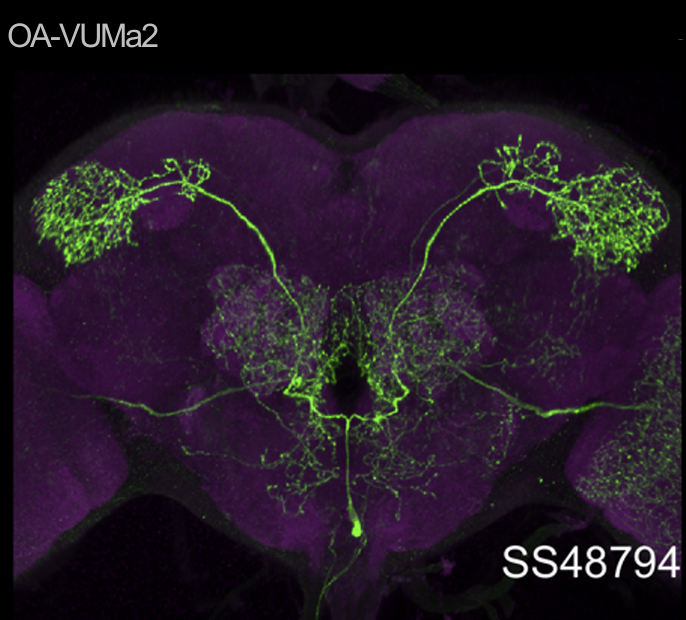
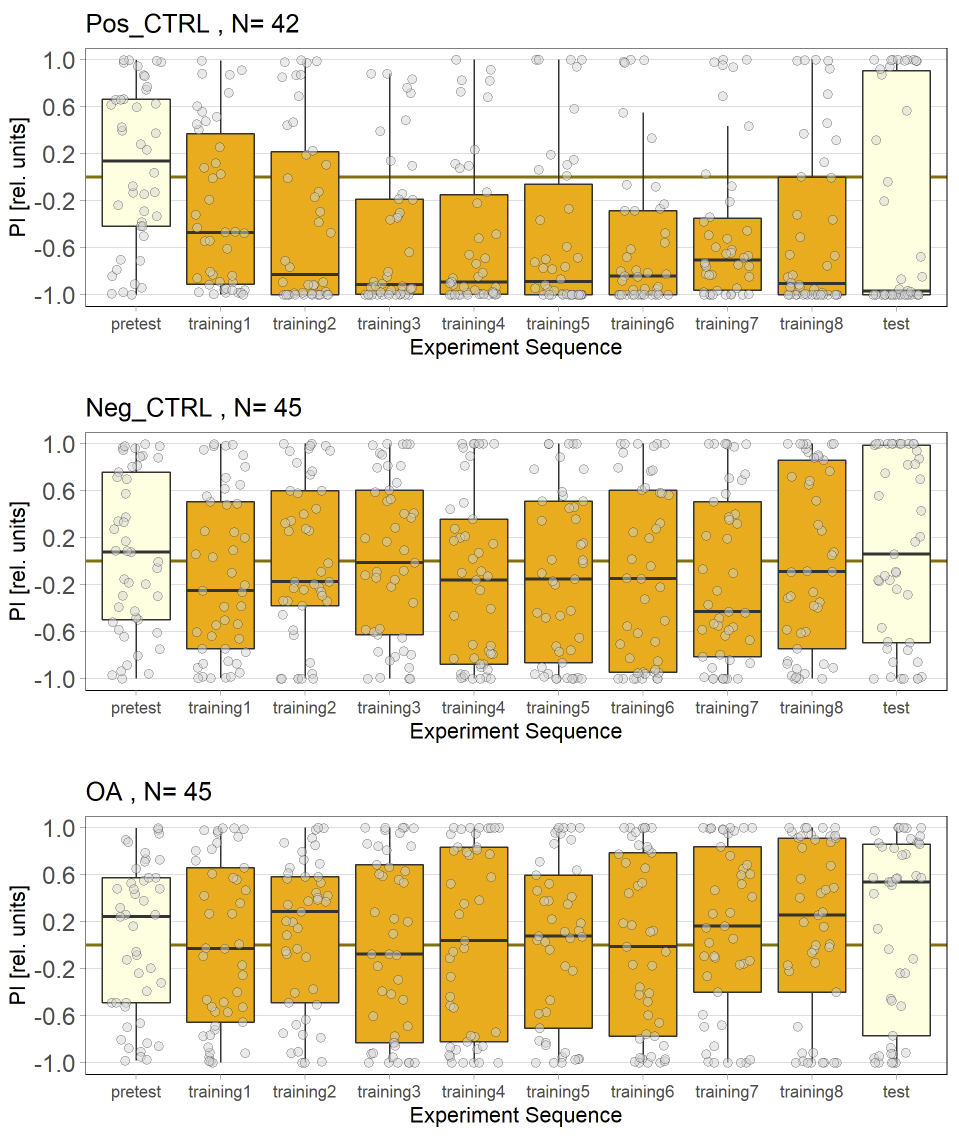
In this set of JoyStick experiments, I tested flies expressing the CsChrimson channel in OA-VuMa octopaminergic neurons, which are the Drosophila counterparts to the honeybee OA-VUMmx1 neurons. There are still a few flies left, but for now activation of these neurons does not seem to mediate any strong innate valence. There may be a slight tendency for approach in the alter periods but it might also be by chance, since we can already observe positive values in the pretest.
Category: Optogenetics | No Comments
Updated results from JoyStick experiments with the “new” control driver line (and some OA flies)
on Monday, October 13th, 2025 12:46 | by Daniel Döringer
Unfortunately I am still dealing with the problem that flies from my negative control group avoided optogenetic activation, even when their optogenetic channel should not work without ATR supplementation. To tackle this problem I used a “new” effector line (I prepared a new stock from our stock collection) for crossings and tested the offspring, without any improvement concerning the avoidance. Unfortunately the “new” effector line I tested turned out to have lost its “NorpA” mutation which would ensure that the male offspring is blind, thus should rule out any phototaxis-bias. Since flies still avoided the light, a) the effector line does not seem to be the problem and b) the ability to see does not seem to affect the flies behavior in the JoyStick setting.
As a next step I targeted the driver line, as maybe a mutation might have lead to an increase in Gal4. Since we always observed a slightly negative values for our negative control group, hinting that at least some residual activation of the CsChrimson channel is possible even without ATR, an increase in Gal4 might lead to a higher expression of the optogenetic channel.
Residual activation + More channels = More residual activation = Our observed avoidance???
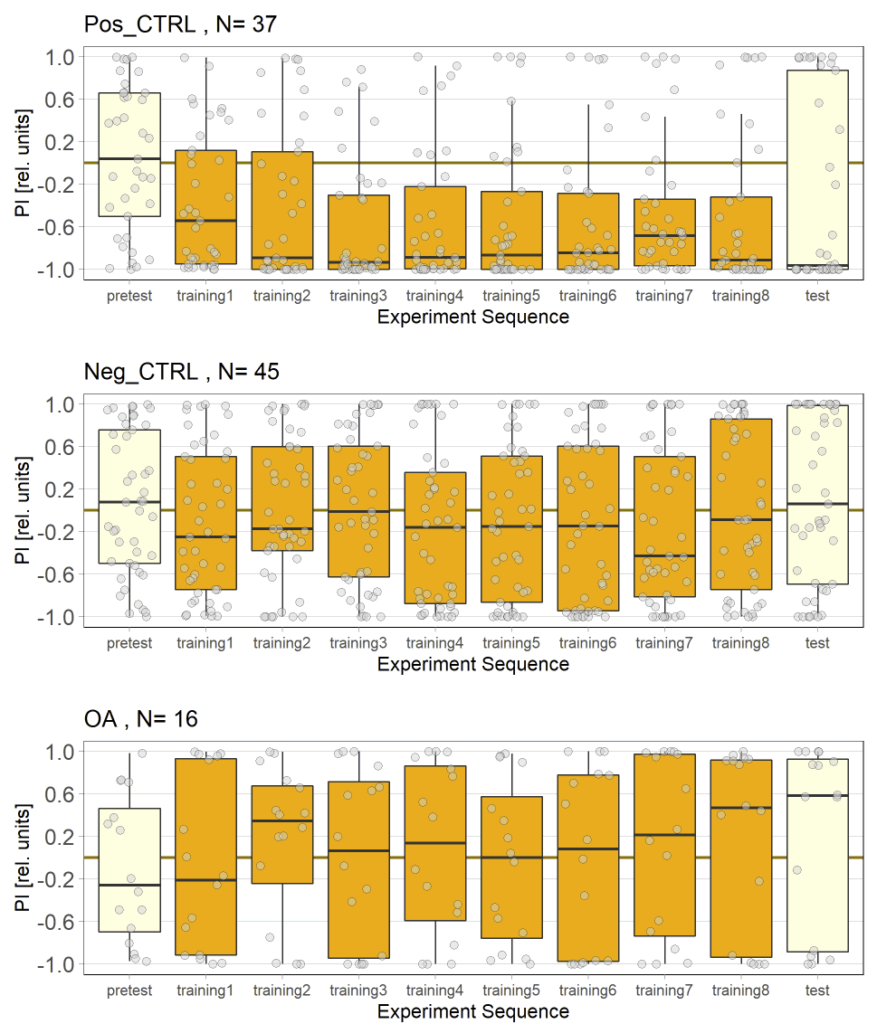
So positive control looks good, negative control is still slightly negative but to an extend that I would consider neglectable.
The additional group here called “OA” are OA;VuMA2 x NorpA, 20xUAS-Chrimson flies. It’s way too early to make any assumptions from the current data but I am looking forward to the results for this group.
Update 27/10/25: Added more flies
Category: Biogenic Amines, Optogenetics | No Comments
First results from optgenetic experiments with PPM2 flies after inhibiting dopamine synthesis with 3IY
on Monday, July 21st, 2025 1:43 | by Daniel Döringer
After last week’s “breakthrough” with our method to sufficiently inhibit dopamine synthesis with 3IY it is time to start testing flies that express the optogenetic Chrimson channel in dopaminergic neurons from the PPM2 cluster.
ATR-Trial: Mix ATR directly with Sucrose / 3IY
Initially I stumbled across another problem, namely that the ATR, which is needed for the Chrimson channel to open, could not be applied in the same way as I did before. Usually, to prepare flies for JoyStick or T-Maze experiments, I would pipet 15µL of ATR onto their food. Here it was important to make sure to spread the ATR evenly across the surface since it has a bitter taste and flies would avoid consuming it if possible. This obviously would be problematic since then the basis of our experiment, optogenetic activation of the target neurons, could not be ensured.
Since for the 3IY treatment flies will not be kept in vials with the standard fly food, but vials with tissue paper soaked with sucrose, it was problematic that the tissue paper would simply soak up all the ATR in one spot. To battle this problem I tried mixing 20µL of ATR directly into the 3IY or sucrose solution. To confirm that this method still works I conducted a first trial only with control flies:
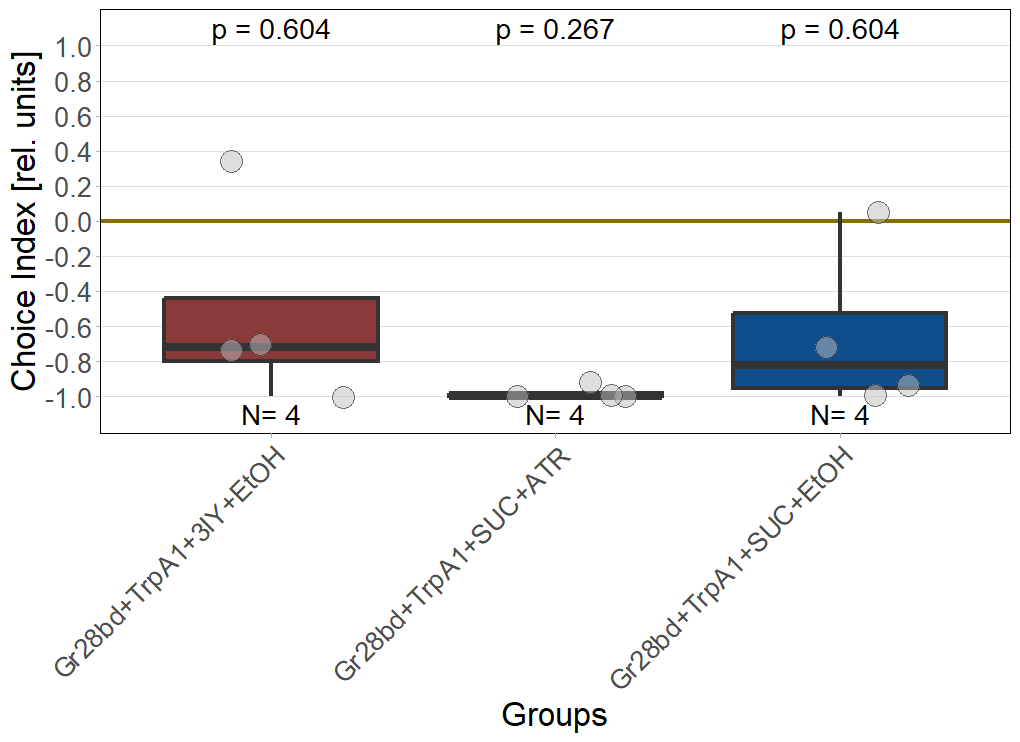
Flies that were kept in vials where the sucrose/3IY solution was not supplemented with ATR should not be affected by the light and should therefore not show any preference (CIs close to zero). Flies that could feed on ATR should avoid the light and show negative CIs, since the fly strain expresses the optogenetic channel in heat-sensing neurons and activation of these neurons would lead to an unpleasant sensation of heat.
The very low sample size is most likely the reason why both Negative control are not 0, but the fact that the group which was supplemented with ATR shows CIs close to -1 indicates that it’s okay to simply mix the ATR with the sucrose/3IY solution.
JoyStick-Results
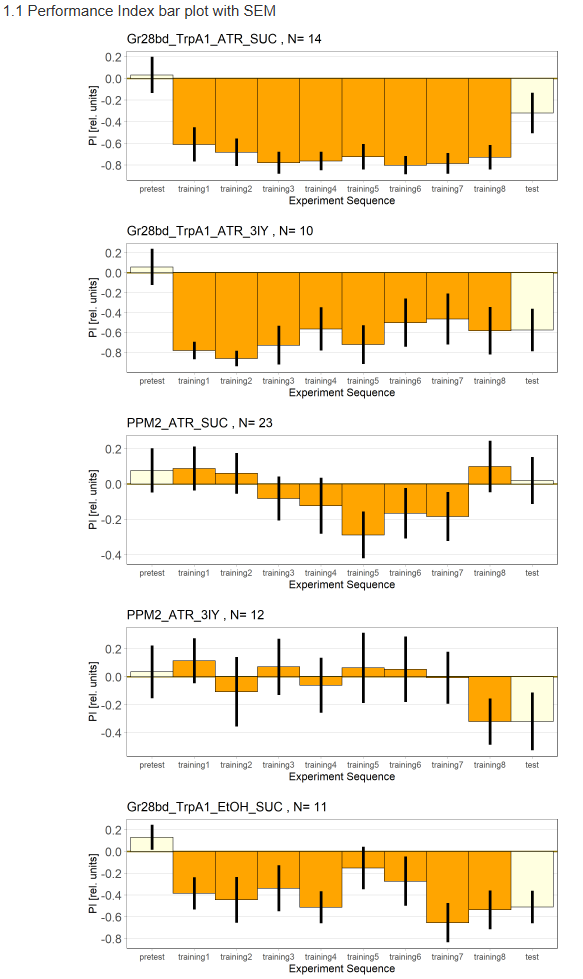
After confirming the method to apply ATR we started JoyStick experiments with 5 groups:
Gr28bd+TrpA1+SUC+EtOH: Control without DA inhibition and no ATR (Negative CTRL)
Gr28bd+TrpA1+SUC+ATR: Control without DA inhibition and ATR (Positive CTRL without DA-inhibition)
Gr28bd+TrpA1+3IY+ATR: Control with DA inhibition and ATR (Positive CTRL without DA-inhibition)
PPM2+SUC+ATR: Experimental group without DA inhibition and ATR
PPM2+3IY+ATR: Experimental group with DA inhibition and ATR

For now the results look okay. CTRL groups with ATR already tend to avoid optogenetic activation, which is good. For all other groups a larger sample size (target = 50) is needed.
Category: Optogenetics | No Comments
JoyStick results for re-testing PPM2 flies
on Monday, June 2nd, 2025 1:58 | by Daniel Döringer
It’s not yet confirmed, that the 3IY treatment is working
Category: Optogenetics, Uncategorized | No Comments
JoyStick results for 13.0273 and SIFa
on Monday, January 20th, 2025 11:05 | by Daniel Döringer
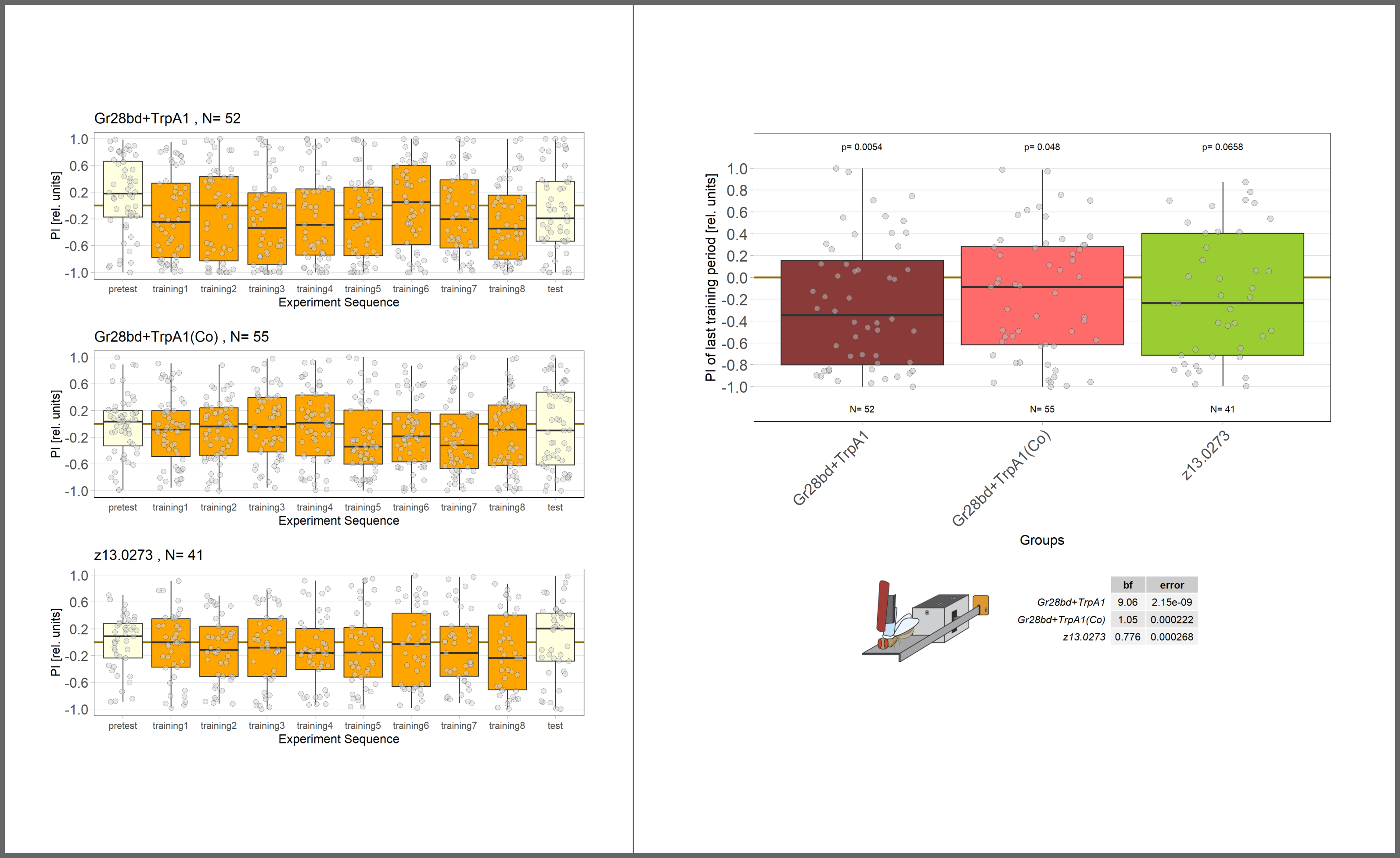
13.0273 (Red)
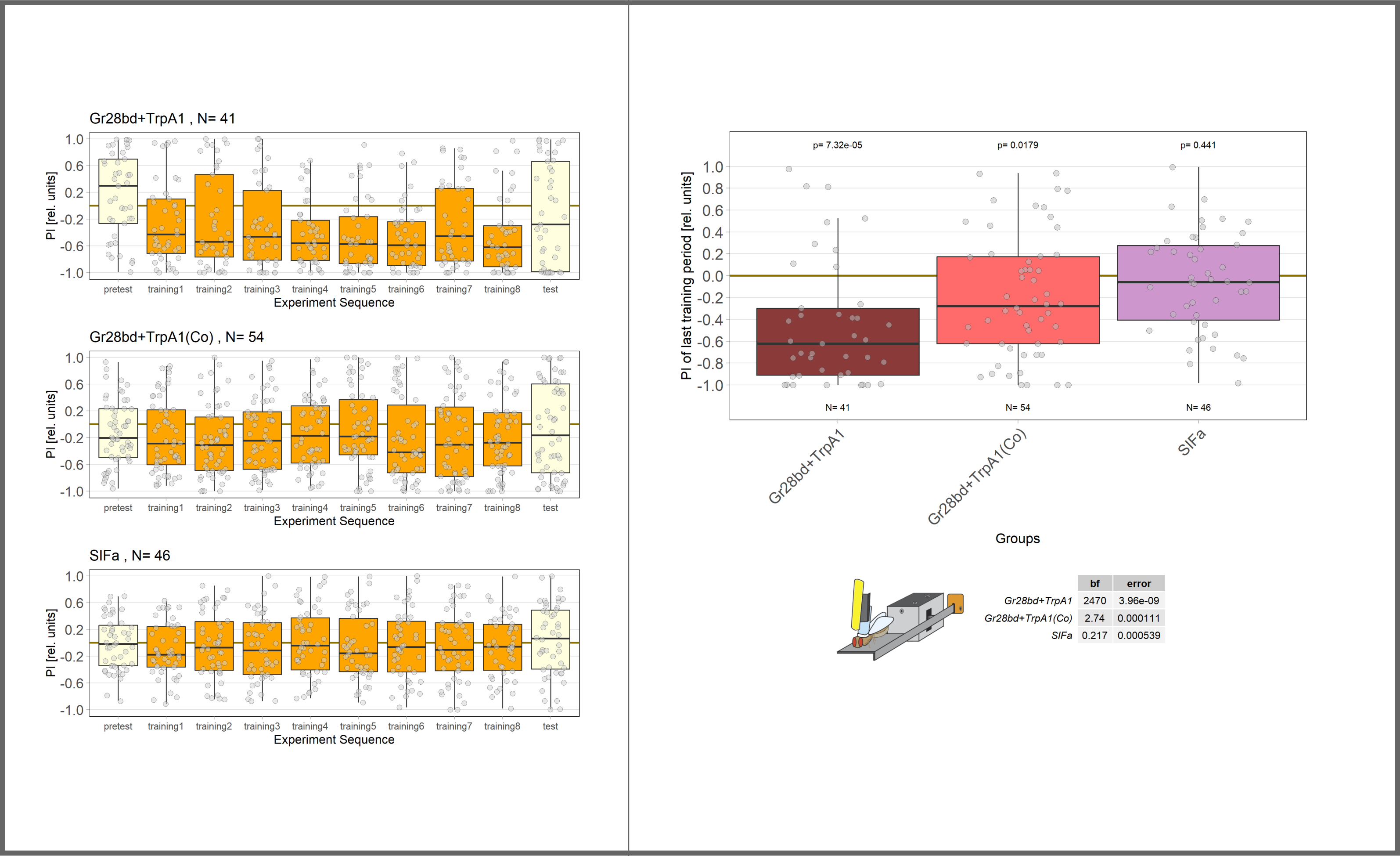
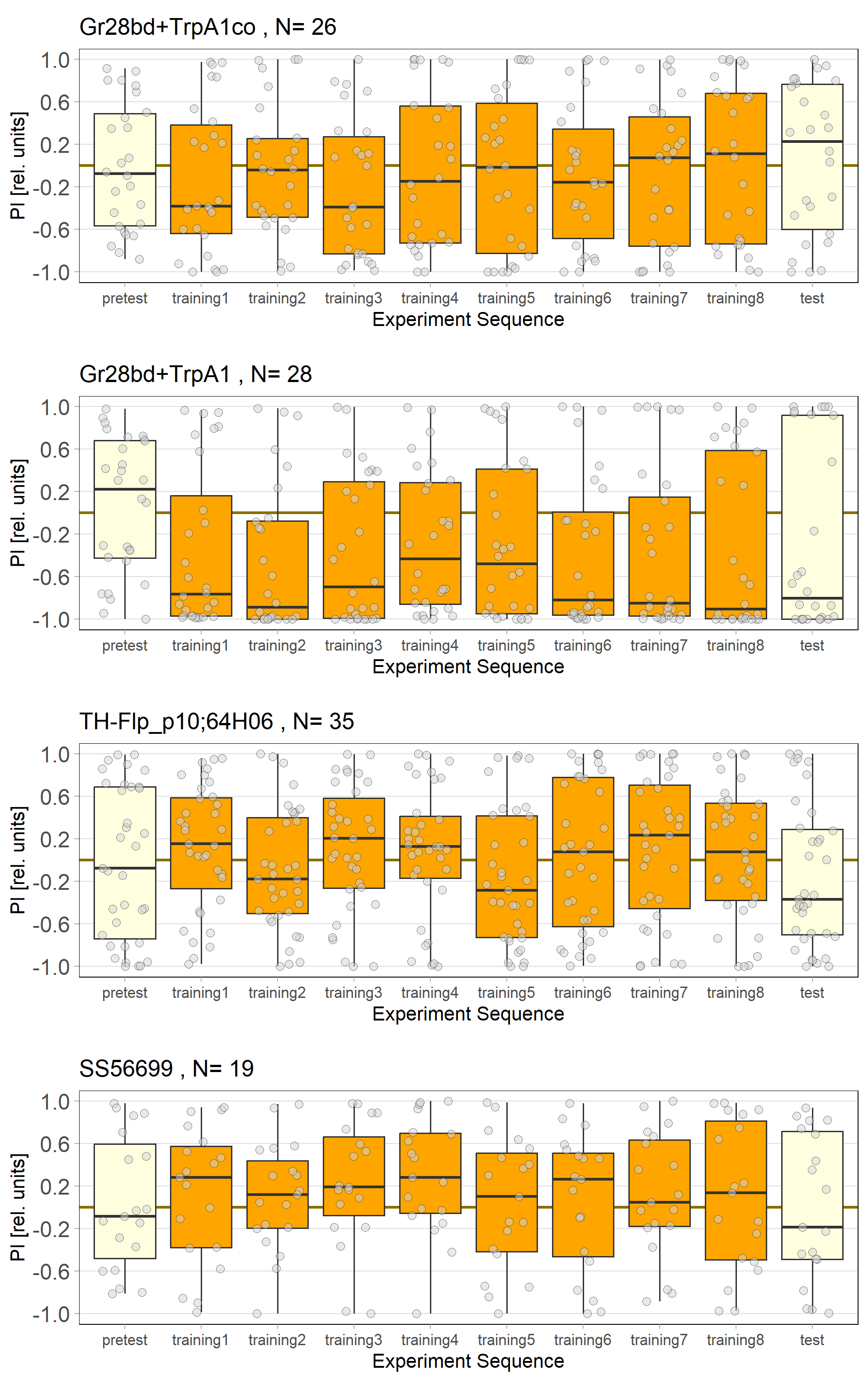
For all Figures the left side displays all 10 testing and training periods for the JoyStick experiment. The right side compares the PIs of the last training period between the groups. Graphics indicate whether red or yellow light was used.
13.0273 (Yellow)

SIFa (Red)

SIFa (Yellow)
Category: Optogenetics | No Comments
T-Maze CIs and JoyStick Last Training PIs for yellow and red light.
on Tuesday, January 7th, 2025 1:45 | by Daniel Döringer
| Strain | DA neurons | Reference |
| SS56699 | PPL1-FB | Hulse et al. eLife 2021 |
| TH-D-DBD; TH-C-AD | PPM2 | Xie et al. Cell Reports 2018 |
| TH-FLP-p10; 64H06 | PPM3 | Xie et al. Cell Reports 2018 |
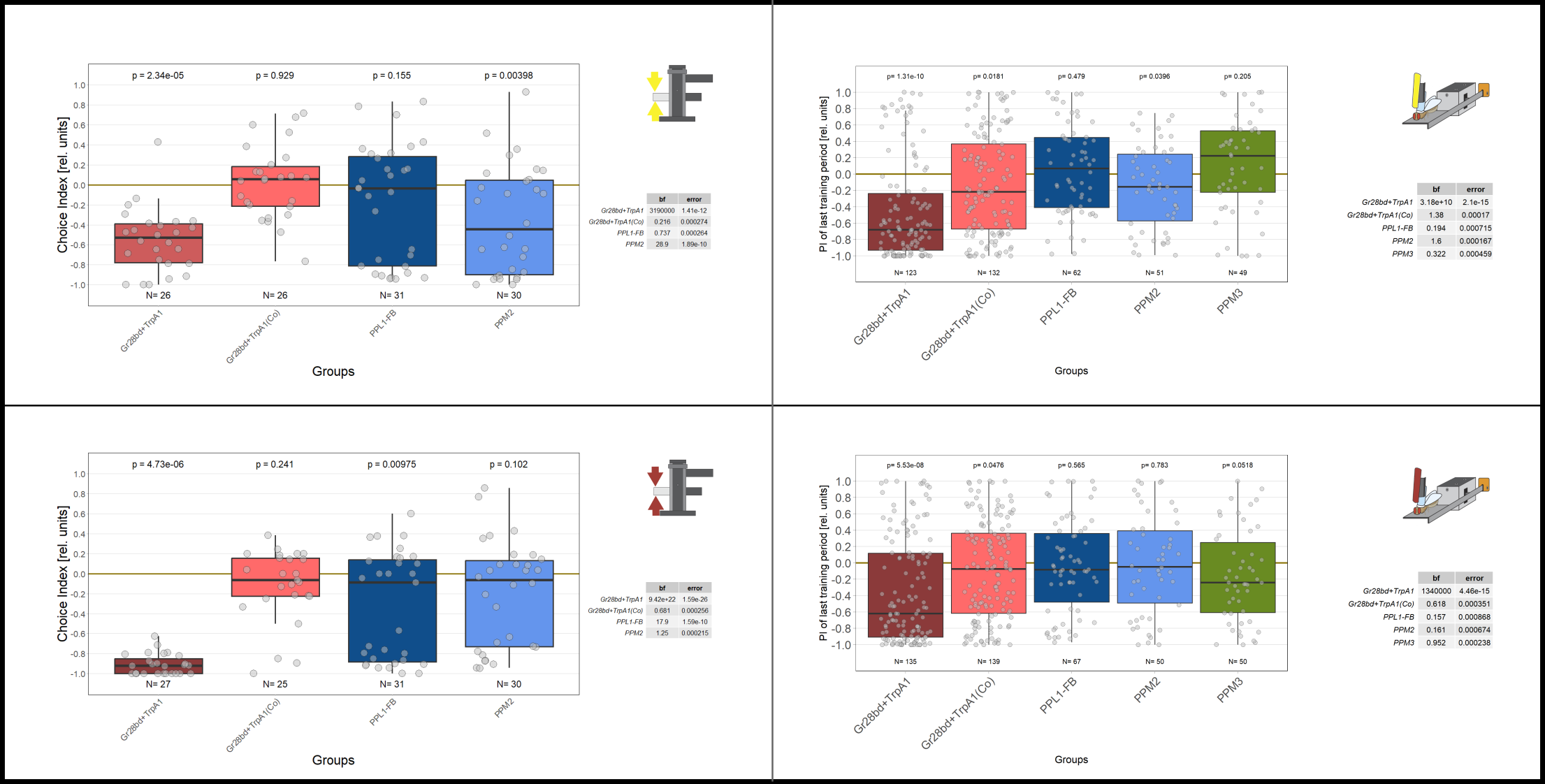
The left-hand side of the figure displays the choice indices (CIs) for the different groups tested for 1 minute in the T-Maze setting. On the right-hand side, the preference indices (PIs) for the final training period in the JoyStick setting are shown. Since flies of the TH_Flp_p10;64H06 line were not blind, they could not be tested in the T-Maze setting. The upper part of the figure refers to experiments conducted with yellow light, while the bottom part to experiments with red light, as indicated by the graphics.
In previous posts I referred to the different dopaminergic neurons (DA neurons) with the names of the driver lines used for the crossings. The table below the figure connects the fly strains to the targeted neurons and gives the reference. Gr28bd+TrpA1 target heat sensing neurons and acted as a control, since flies expressing the chrisom channel in these heat sensing neurons would avoid light activation. Flies were fed with all-trans retinal (ATR) for 2 days before the experiments, to enable light activation of the targeted neurons. For the negative control ethanol was used.
In the T-Maze experiments, flies were tested for 1 minute without prior exposure to light, whereas the JoyStick results reflect preferences after nine 1-minute training periods. Therefore, the T-Maze experiments should be repeated using longer testing periods. Additionally, PIs from the initial training periods in the JoyStick experiments will be included to allow for better comparison.
Hulse et al. eLife 2021: https://doi.org/10.7554/eLife.66039
Xie et al. Cell Reports 2018: https://doi.org/10.1016/j.celrep.2018.03.068
Category: Optogenetics | No Comments
Joystick results Yellow light, testing with and Without food
on Monday, November 25th, 2024 1:31 | by Philipp Doms
The positive control was tested once without food and once with food to observe its effect on general behavior, particularly on learning behavior. NF = No Food / WF = With Food

Category: Optogenetics, Uncategorized | No Comments
All Joystick Results Yellow
on Monday, November 11th, 2024 11:16 | by Philipp Doms

Category: Optogenetics | No Comments
All Joystick Results Red
on Monday, November 11th, 2024 11:14 | by Philipp Doms

Category: Optogenetics | No Comments
Joystick Results Yellow Light 29.10.24
on Tuesday, October 29th, 2024 2:19 | by Philipp Doms
Category: Optogenetics | No Comments