First results of salt (1.5 M) avoidance tests in groups A, B, and C under red light
on Saturday, January 31st, 2026 9:00 | by Lucia Grünberger
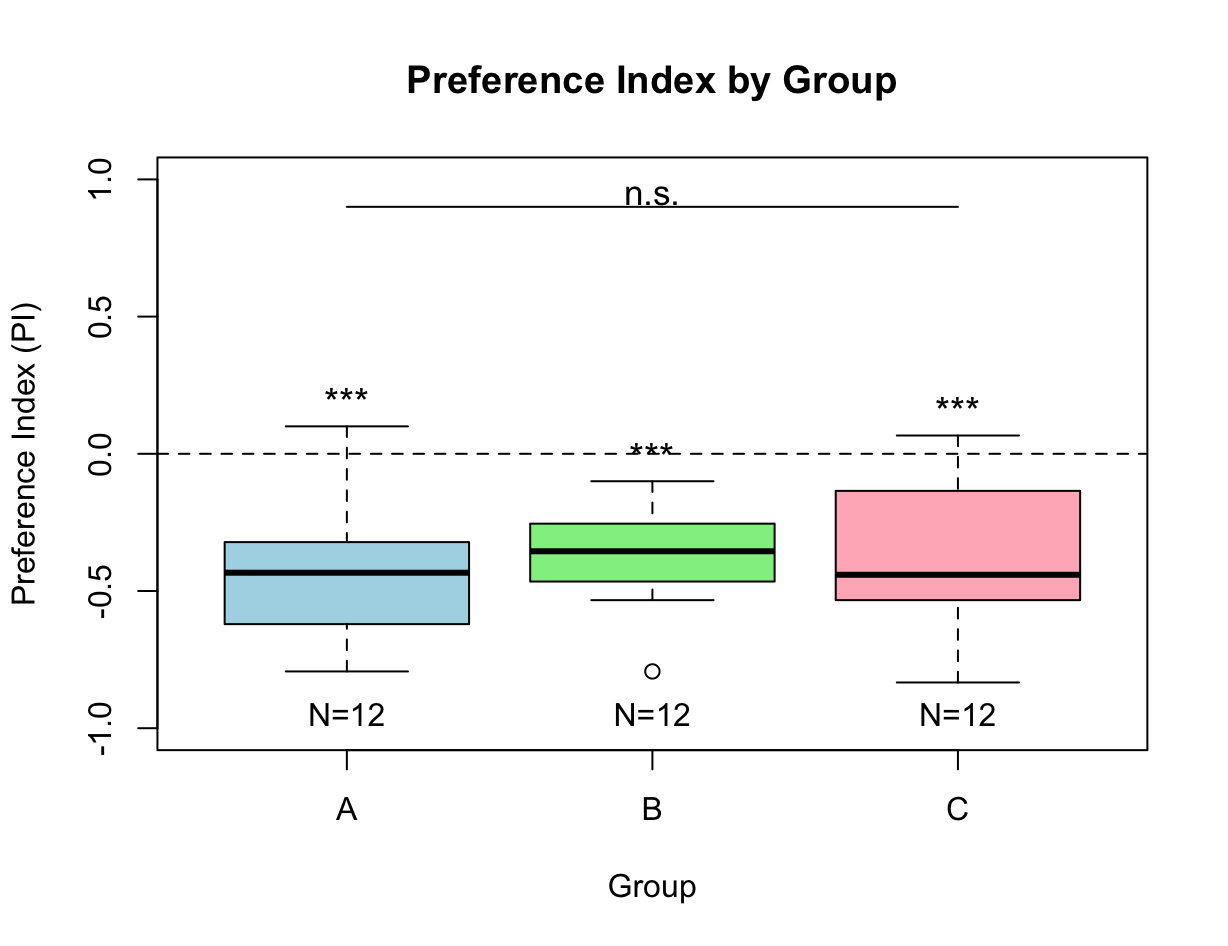
Drosophila larvae from three groups (A, B, and C) were placed in the center of an agar plate containing plain agar on one side and salt-containing agar (1.5 M) on the other. After 3 minutes, larval distribution was quantified using a preference index under red light. All three groups showed a significant avoidance of salt. No significant differences in salt avoidance were observed between the groups.

Category: Food preference, Larvae | No Comments
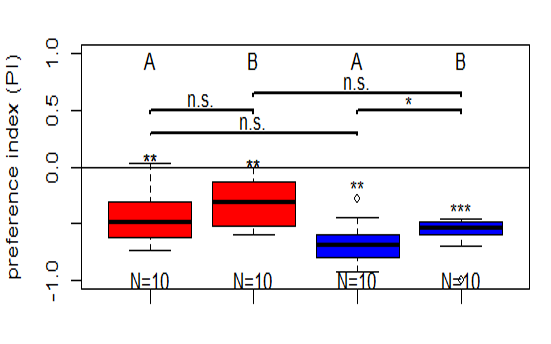
Salt (1.5 M) avoidance test in [ChR2-XXL/Cy0 Dop1R2-RNAi/Tm3] larvae under red and blue light
on Friday, January 30th, 2026 4:23 | by Christoph Kumpfmüller
Category: crosses, Larvae, Mushroom Body, Optogenetics | No Comments
Optogenetic activation of Mushroom body Kenyon cells affects naïve salt avoidance in Drosophila larvae
on Monday, January 26th, 2026 11:58 | by Radostina Lyutova
The mushroom bodies (MBs) are known to be the most prominent olfactory memory center in Drosophila. The MB Kenyon cells receive olfactory (via projection neurons, PNs) and gustatory (via dopaminergic neurons, DANs) input. The coincident detection of these stimuli elicits then the formation of associative memory. However, little is known whether and how this high order brain center affects naïve behaviors such as olfaction and gustation. We use fruit fly larvae to test the innate salt avoidance in a simple choice assay. Drosophila larvae are tested for 3 minutes for their preference for 1.5M NaCl. We show that salt avoidance is enhanced upon optogenetic activation of the Kenyon cells. This effect was also observed after ablation of pPAM DANs with simultaneous optogenetic activation of the KCs. We were able to phenocopy this effect by optogenetic activation of TH-Gal4 positive dopaminergic neurons, however not after artificial activation of single DANs of the DL1 cluster. In contrast, larvae showed no salt avoidance after optogenetic activation of sNPF-Gal4 positive neurons. Neuropeptidergic and dopaminergic signaling are tightly involved in modulation of the MBs. However, it is not clear whether our observations depend on coherent neuronal pathways. Therefore, we use simultaneous manipulations of different components of the MB, dopaminergic and sNPF circuitries to unravel the neural mechanisms of modulation of naïve gustatory behaviors in the Drosophila larvae.
Category: Biogenic Amines, DAN, Food preference, Kenyon cells, Larvae, Mushroom Body, neuronal activation, Optogenetics, PAM | No Comments
Salt avoidance test in control larvae (WTB) under red light and blue light (combined data)
on Monday, January 26th, 2026 10:35 | by Lucia Grünberger
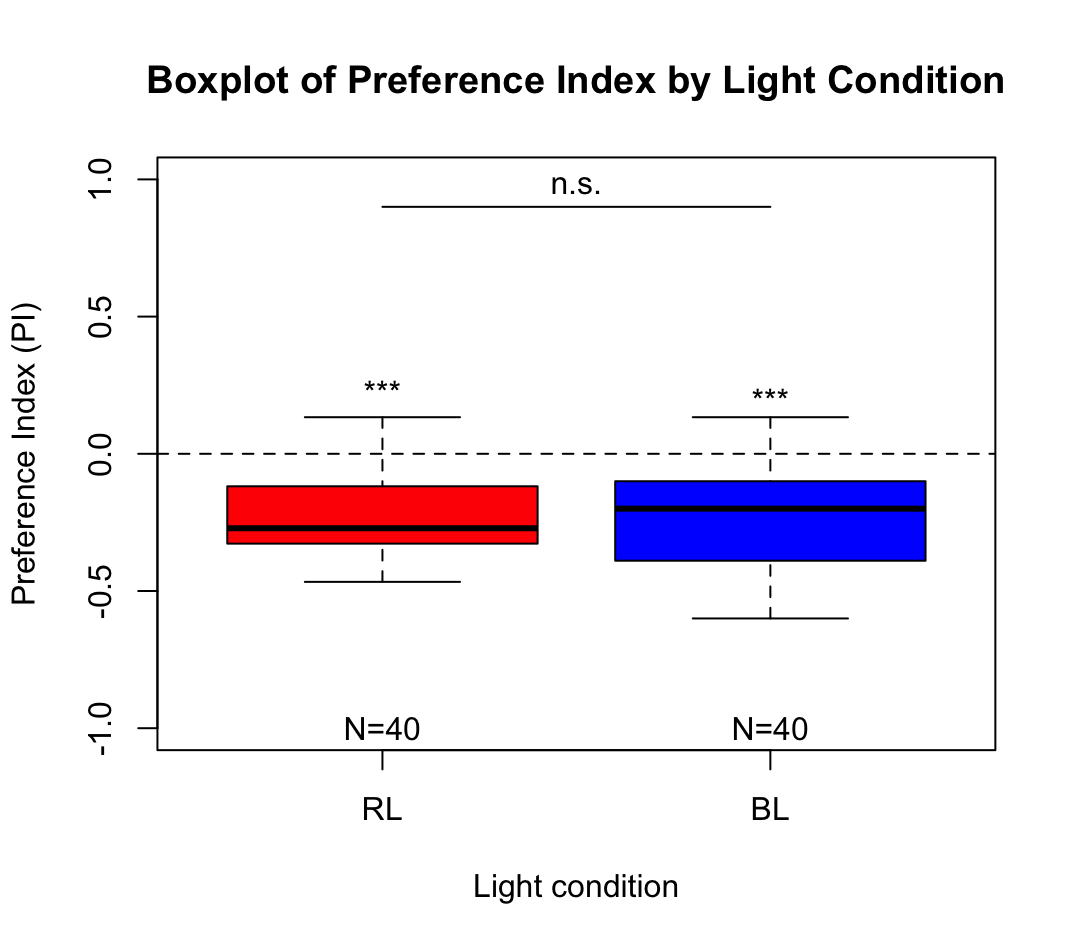
Larvae showed a significant avoidance of salt under both light conditions. When data from both weeks were combined, no significant difference in avoidance was observed between blue and red light.
Category: Food preference, Larvae | No Comments
Salt avoidance test in control larvae (WTB) under red light and blue light
on Monday, January 26th, 2026 10:26 | by Lucia Grünberger
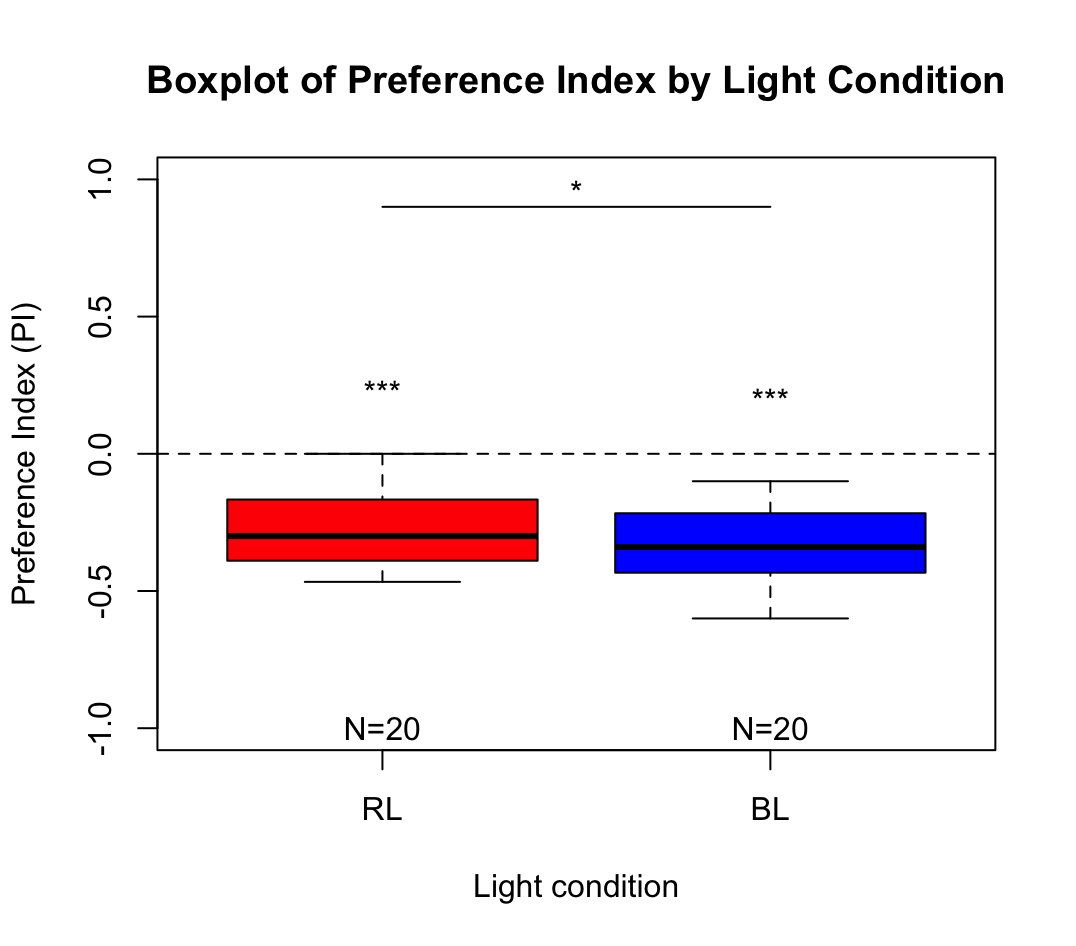
WTB Drosophila larvae were placed in the center of an agar plate with plain agar on one side and salt-containing agar on the other. After 3 minutes, larval distribution was quantified as a preference index under red and blue light.
Larvae showed a significant avoidance of salt under both light conditions. Avoidance was significantly stronger under blue light than under red light.
Category: Food preference, Larvae | No Comments
Salt avoidance test in control larvae (WTB) under red light and blue light
on Monday, January 19th, 2026 9:40 | by Lucia Grünberger
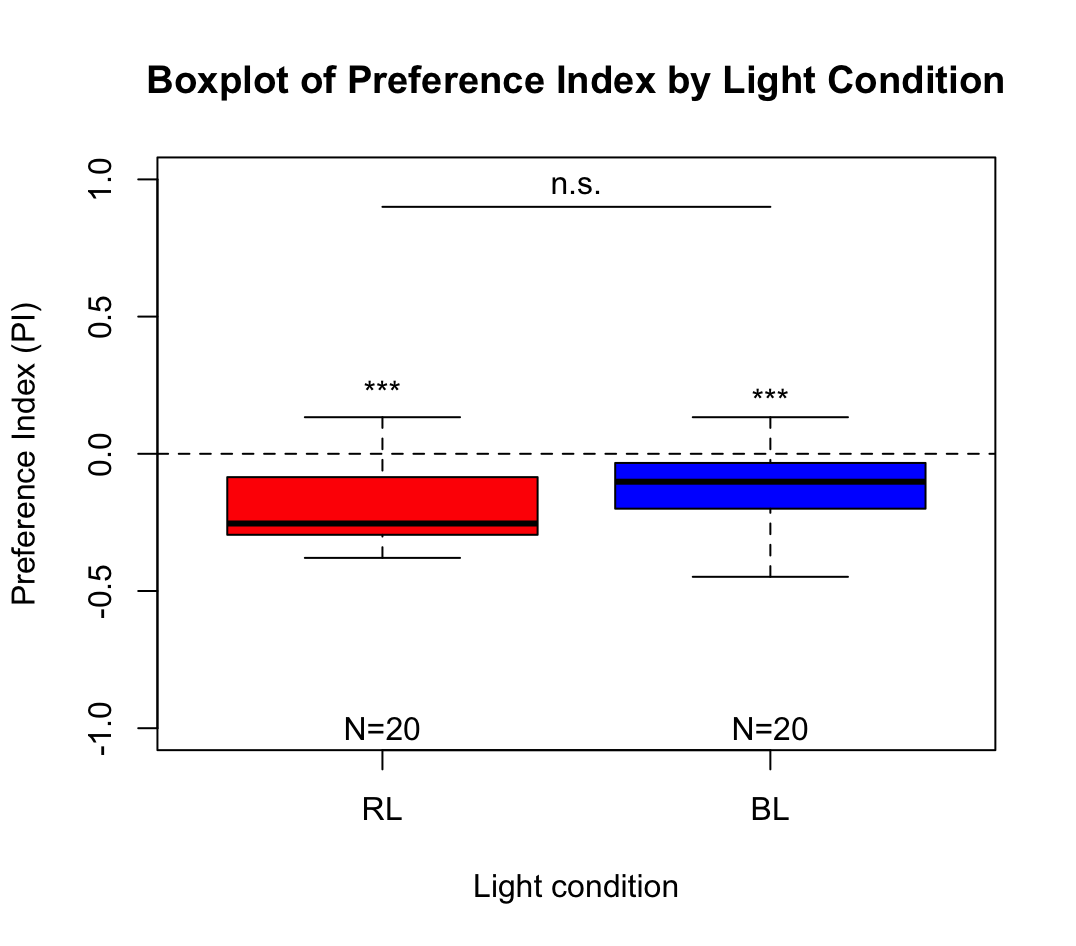
WTB Drosophila larvae were placed in the center of an agar plate containing plain agar on one half and agar supplemented with salt on the other half.
Larval distribution after 3 minutes was quantified as a preference index under red and blue light conditions.
Category: Food preference, Larvae | No Comments
Salt avoidance
on Monday, December 15th, 2025 9:24 | by Radostina Lyutova
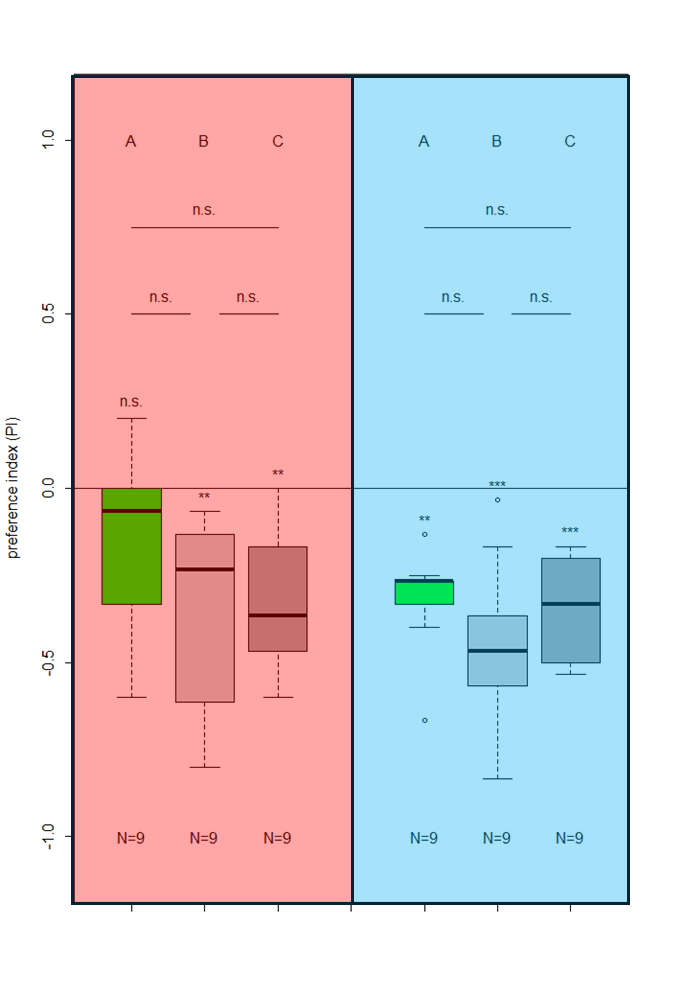
5 days old larvae (3rd instar) were tested for their salt (1.5 M) avoidance behavior. Dopaminergic neurons from the TH-D’ cluster were activated upon ChR2-XXL expression and blue light exposure, respectively.
Category: Biogenic Amines, DAN, Food preference, Larvae, neuronal activation | No Comments